OpenAI is putting ads in ChatGPT — but they run on separate systems and can't influence answers. That one line reshapes your AI search budget. Here's the earned-vs-paid playbook for CMOs.
OpenAI just did the thing every marketer swore it never would: it's putting ads in ChatGPT.
The context is what makes it matter. ChatGPT crossed 1 billion monthly active app users in May 2026 — the fastest product in history to reach that mark, quicker than Chrome, YouTube, or TikTok ever managed (PYMNTS, citing Sensor Tower, June 2026). That audience is now getting ads.
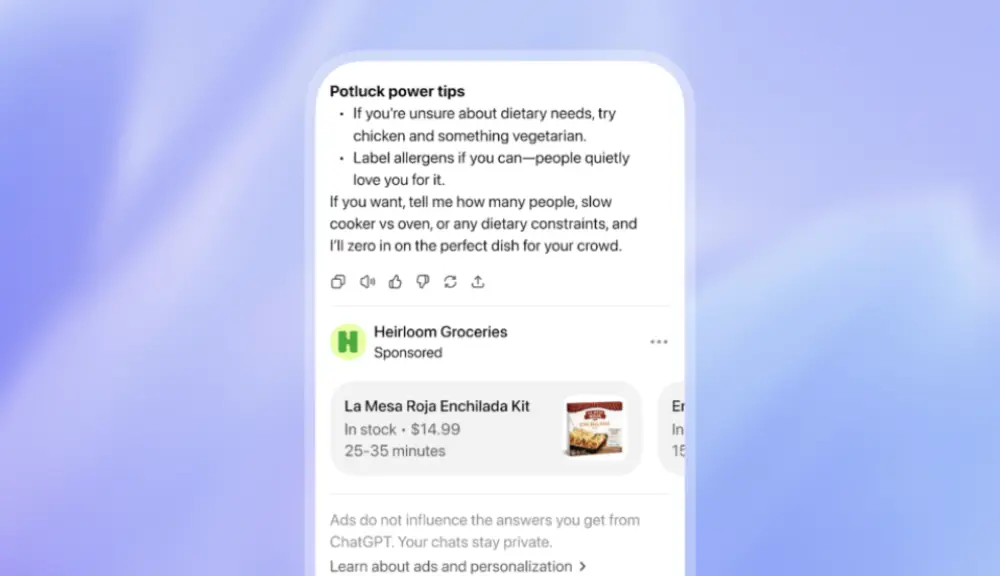
The test starts in the US on February 9, 2026. Ads show up for Free and Go users only — Plus, Pro, Business, Enterprise, and Edu stay ad-free, and no account predicted or declared to be under 18 sees them. Each ad sits below a response, labeled sponsored, visually walled off from the answer itself.
Cue the panic. "The AI is selling out." "Organic AI visibility is dead." "You have to pay to show up in ChatGPT now." Every one of those takes is wrong.
Here's the real story, and it's better than the panic: ChatGPT Ads don't threaten GEO. They validate it. In documenting how the paid layer works, OpenAI handed you the clearest map yet of how the organic layer works — and the two are deliberately, architecturally separate. Understand that separation and this announcement is an opportunity, not a threat. Miss it and you'll waste budget chasing the wrong surface.
What OpenAI Actually Announced
OpenAI is testing a single sponsored ad unit below ChatGPT responses for Free and Go users in the US, beginning February 9, 2026 (OpenAI, 2026). Paid tiers stay ad-free. The rollout is phased and expands as OpenAI learns from real use.
The stated reason is blunt: hundreds of millions of people use ChatGPT, and keeping the Free and Go tiers fast costs real money. Ads subsidize free access. That's it. No grand reinvention of the product.
Who actually sees an ad is the part worth memorizing:
Plan | Sees ads? |
|---|---|
Free | Yes — eligible |
Go | Yes — eligible |
Plus | No |
Pro | No |
Business | No |
Enterprise | No |
Edu | No |
Under-18 (declared or predicted) | No |
Logged-out | Age-appropriate ads only |
Ads never appear in Temporary Chats. They're excluded from sensitive contexts — personal health, mental health, and politics. During the test they also stay out of the ChatGPT Atlas browser. And the format is deliberately modest: advertiser name, favicon, a headline, a line of copy, a landing page, and one image. This isn't a banner farm. It's one card, below the answer, when there's a genuine match.
So the surface area is small and the audience is specifically the non-paying tier. That alone should reset how you weigh this against your existing paid channels.
The Line That Changes Everything: Ads Can't Touch the Answer
OpenAI states it plainly: ads run on separate systems from the chat model, and advertisers have no ability to shape, rank, or alter ChatGPT's responses (OpenAI, 2026). Read that twice. You cannot buy your way into the answer.
This is the most important sentence in the whole announcement, and most marketers will skim right past it. It means AI search now has two completely separate surfaces:
The answer — generated by the model, grounded in retrieved sources through retrieval-augmented generation. Earned. You get cited here by being the most credible, most relevant source. No amount of ad spend moves it.
The sponsored unit — a paid card below the answer, won through an auction. It sits next to the answer. It never gets inside it.
OpenAI reinforces the wall from every angle. Seeing an ad doesn't mean OpenAI endorses the advertiser. By default, ChatGPT can't even see the ads shown to you. Advertisers get no access to your chats, memory, or identity — only aggregate performance numbers. The paid layer and the intelligence layer are quarantined on purpose, because the moment users suspect the answer is for sale, the product is dead. OpenAI knows it, and says outright that it prioritizes trust over revenue and doesn't optimize for time spent.
Here's why that matters to you. If you've read our breakdown of why GEO is still SEO, this rhymes exactly. Google said the same thing about AI Overviews — the citation is earned through the same quality systems that rank organic results. Now OpenAI confirms the paid layer is fenced off from the earned one. Two of the largest players in AI search independently drew the identical line. That's not a coincidence. That's the architecture of the entire category.
Earned vs. Paid: The Two Real-Estate Layers of AI Search
The strategic mistake CMOs are about to make is treating ChatGPT Ads as a replacement for AI visibility work. It's not. It's a second, narrower surface with completely different economics. Here's how the two layers actually compare:
Dimension | Earned citation (the answer) | Paid ad unit (sponsored card) |
|---|---|---|
How you win it | Relevance, credibility, first-hand content the model retrieves | An auction bid plus relevance |
What it costs | Content and technical investment; no per-click fee | CPM or CPC — real money per impression or click |
Influence on the answer | You ARE part of the answer | Zero — it can't shape the response |
Where it sits | Inside the response, with the citation link | Below the response, labeled sponsored |
Trust signal | High — reads as the model's own sourcing | Lower — users know it's paid |
Who it reaches | Every tier, including Plus/Pro/Enterprise | Free and Go users only |
Durability | Compounds as long as you stay the best source | Stops the moment the budget stops |
Look at the reach row again. The paid unit can't touch your highest-value audience — Plus, Pro, Business, and Enterprise users are exactly the CMOs, founders, and technical buyers you most want in front of, and they will never see an ad. The only way to reach them inside ChatGPT is to be cited in the answer. That's earned. That's GEO.
And ChatGPT isn't the whole market anyway. It holds roughly 52.1% of the US generative-AI chatbot market, with Claude at 21.5%, Gemini at 13.3%, and Perplexity at 3.4% (First Page Sage, June 2026; note that share figures vary by methodology across vendors). So ChatGPT Ads buy you a slice of one platform's non-paying users. Earned citations reach all of them, across every engine. If you optimize only for the ad, you've written off nearly half the market before you start.
This is why measuring your presence across engines matters more than ever. You need to know where you're already being cited before you spend a dollar on the card below it. That's the job of specialized LLM visibility analysis software — it tells you whether you're winning the free, trusted, answer-embedded placement, or leaving it to a competitor while you bid on the paid scraps.
Visibility Isn't the Same as Being Believed
Getting cited is necessary. It isn't sufficient. New June 2026 research from Burson, working with Profound, names the trap directly: a credibility paradox, where showing up in AI answers doesn't mean being believed (Burson, June 2026). The study scored more than 55,000 believability forecasts across seven AI answer platforms.
Two findings should reshape how you write for AI. First, audience matters: business decision-makers rate AI answers about brands roughly 10% more convincing than the general public does — so your B2B buyers are already inclined to trust what the model says about you. Second, claim type matters: fact-based statements (products, innovation, workplace) are believed more readily than subjective ones (leadership, governance).
The tactical read is simple. Earn the citation, then make sure what the model can extract about you is concrete, specific, and verifiable — numbers, capabilities, first-hand results — not adjectives about how visionary you are. Visibility gets you into the answer. Verifiable substance is what makes the answer work in your favor. This is the same first-hand-content discipline behind mastering GEO for B2B tech platforms.
How the ChatGPT Ads Auction Actually Works
OpenAI runs a relevance-weighted, second-price auction to pick the ad for an eligible conversation (OpenAI, 2026). If your bidding instincts come from Google Ads, most of this will feel familiar — with a few important differences. Here's the mechanical breakdown:
Objective | Optimizes for | You pay per | Bid you set |
|---|---|---|---|
Reach | Impressions | 1,000 impressions | Maximum CPM |
Clicks | Clicks | Valid click | Maximum CPC (start $3–$5) |
Two mechanics deserve real attention, because they change how you should think about targeting.
First, "relevance-weighted" is the whole game. A lower bid attached to a highly relevant ad can beat a higher bid that's a poor match. This is Quality Score logic ported into AI search — and it's the same principle that governs earned citations. Relevance wins on both layers. If your product genuinely fits the conversation, you pay less to show up. If it doesn't, no bid saves you.
Second, advertisers provide context hints at the ad-group level — descriptions of the conversations, topics, or keywords where their product fits. OpenAI is explicit that these are not exact-match keywords and do not guarantee delivery. You're describing intent, not buying a string. Marketers trained on rigid keyword match types need to unlearn that reflex. ChatGPT reads the conversation, not your keyword list.
The pricing takeaway for a first test: start Clicks-objective at a $3–$5 max CPC, keep your context hints tight and honest, and let relevance do the heavy lifting. Ads Manager will surface bid-strength guidance to tell you whether you're competitive. Don't over-bid to compensate for a weak match — fix the match.
The Measurement Trap Nobody's Warning You About
ChatGPT Ads reporting currently gives you impressions, clicks, spend, CTR, average CPC, average CPM, and conversions (OpenAI, 2026). Useful, but aggregate. And that aggregation is where unprepared teams will lose the plot on attribution.
Here's the constraint: advertisers receive aggregated, non-identifying data only. No chats. No chat history. No memories. No name, email, precise location, or IP. You will never get user-level attribution the way some channels have spoiled you into expecting. Plan your measurement around that reality from day one, not after your first invoice.
Two things to set up before you spend:
Conversion measurement in Ads Manager — configure it so clicks tie back to real outcomes, not just traffic.
Static UTM parameters on every landing-page URL — OpenAI confirms these persist on ad clicks, so your existing analytics stack can isolate ChatGPT-sourced traffic. This is your bridge between OpenAI's walled reporting and your own funnel data.
Without both in place, you'll have spend on one side and revenue on the other with nothing connecting them. The teams that instrument this correctly will know their true cost per acquisition on ChatGPT while everyone else is guessing. If you want the tooling layer that stitches AI-channel data into a coherent picture, that's exactly what advanced semantic routing and AI search engine optimization tools are built to handle.
Privacy and Brand Safety: The Guardrails That Decide Who Can Even Play
OpenAI's policy places ads only near chats that are safe, appropriate, and brand-aligned — and it hard-excludes sensitive contexts including personal health, mental health, and politics (OpenAI, 2026). Political advertising isn't allowed in ChatGPT at all right now. These aren't soft preferences. They're structural limits on where the paid layer can operate.
Some regulated verticals — health, financial services — may qualify to advertise under strict eligibility criteria. But even when eligible, their ads still won't be placed near sensitive user content. So if you operate in a regulated category, the paid surface is narrow and conditional by design.
That constraint has a strategic flip side, and it's the whole point. Where paid is restricted, earned is unrestricted. A citation in the answer isn't governed by ad brand-safety rules — it's governed by whether you're the most credible source. For regulated industries locked out of the sensitive-topic ad inventory, the earned citation isn't just the better lever. It's often the only one.
On privacy: conversations aren't shared with advertisers, data is never sold, personalization is user-controlled, and cleared ads data is purged within 30 days. For advertisers that means less targeting granularity than social platforms — and for the strategist it means, again, relevance and context beat surveillance. The exact same currency that wins the earned layer.
What This Means for Your Budget and Your Pipeline
Now the reality check the hype will skip. For all the noise, ChatGPT ads are tiny today. Standalone AI chatbots — ChatGPT and every competitor combined — are forecast to generate under $1 billion in US ad revenue in 2026, reaching only about $5 billion by 2030 (eMarketer, June 2026). For scale, total US AI ad spend is projected around $32 billion in 2026 on the way to $68.25 billion by 2030 — and more than 80% of it runs next to AI content like Google's AI Overviews, not inside chatbots.
Read that against the other trend line. In the first four months of 2026, about 68% of Google searches ended with no click to the open web at all (SparkToro, June 2026). Discovery is moving into the answer while clicks dry up. Put the two together and the strategy is obvious: the earned citation — the free, trusted placement inside the answer, seen by every tier — is the compounding asset. The ChatGPT ad is a small, optional, still-experimental add-on.
So the answer isn't paid versus earned. It's sequencing.
Earn the citation first. It reaches your premium audience, carries the model's implied trust, and doesn't stop when the budget does. If you have to choose one, choose this.
Test the ad second. Beta means low competition and cheap clicks. A disciplined Clicks campaign at a $3–$5 CPC, aimed at Free and Go users, is a cheap way to learn the channel while it's uncrowded — just size the bet to a sub-$1-billion market, not the hype.
Instrument both. UTMs and conversion tracking from the start, so you can prove which layer drives pipeline instead of arguing about it later.
The agencies that spent 2025 selling "GEO" as a mystical new discipline are about to pivot to selling "ChatGPT Ads management" as the next miracle. Both framings miss it. This is one integrated AI-search strategy with an earned layer and a paid layer, and the same currency — relevance and credibility — wins on both. If you want the foundation under all of it, start with the tactical differences in traditional SEO, AEO, and GEO.
The actionable takeaway: ChatGPT Ads confirm what Google already told us — the answer is earned and the ad is bought, and the two never touch. With a billion-user audience but under $1 billion in chatbot ad revenue in 2026, and two-thirds of searches now ending without a click, the smart money isn't reallocating GEO budget into the auction. It's funding both and sequencing them: win the citation first, because it reaches the paid tiers that never see an ad and compounds for free, then run a lean Clicks test at a $3–$5 CPC while the beta is uncrowded — UTMs and conversion tracking wired in before the first dollar. Make what the model can quote about you concrete and verifiable, because visibility without believability is just noise. The advertisers who treat this as one system — earned above, paid below, relevance winning both — will own AI search while everyone else argues about which one replaced the other. Neither did. You need both, in that order.